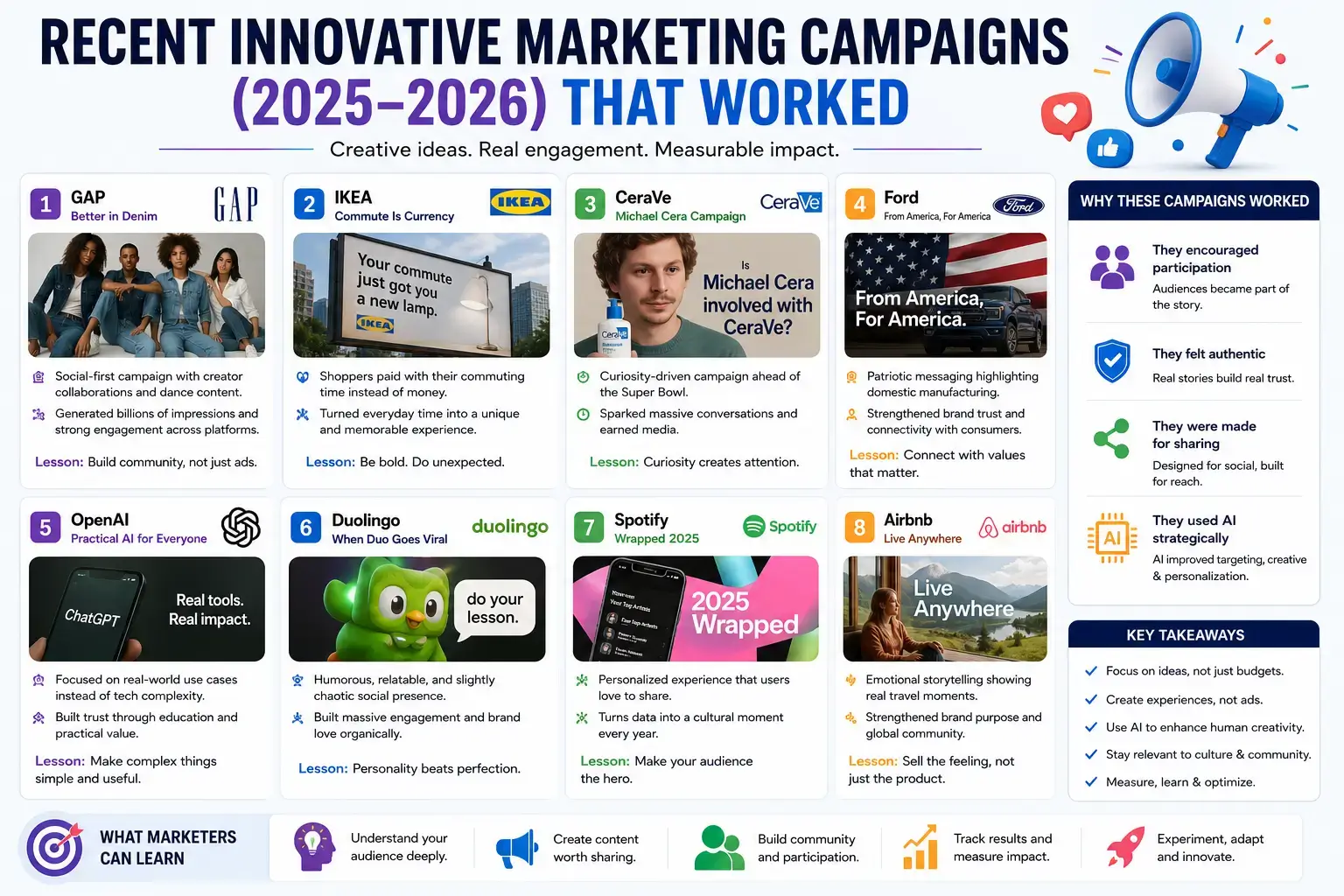
The most successful marketing campaigns in 2025 and 2026 shared one trait: they created experiences people wanted to participate in rather than advertisements people wanted to skip. Instead of relying on bigger budgets alone, leading brands combined AI, creator partnerships, cultural relevance, personalization, and real-world experiences to earn attention and engagement.
Rather than listing campaigns, this guide explains what each campaign did, why it worked, and what marketers can realistically learn from it.
What Makes a Marketing Campaign Innovative Today?
Innovation no longer means using the newest technology.
Today’s best campaigns usually combine several elements:
- Solving a real customer problem
- Strong storytelling
- AI-assisted personalization
- Social-first creative
- User participation
- Cultural timing
- Authentic brand voice
Brands increasingly use AI to speed up creative production, improve targeting, and personalize customer experiences, but successful campaigns still rely on human insight and creativity.
The Biggest Marketing Trends Defining 2025–2026
Across industries, several themes appear repeatedly:
| Trend | Why It Works |
|---|---|
| AI-generated creative | Faster production and personalization |
| Creator partnerships | Higher trust than traditional advertising |
| Community participation | Turns audiences into promoters |
| Experiential marketing | Creates memorable offline experiences |
| Cultural relevance | Makes brands part of current conversations |
| Interactive campaigns | Encourages sharing and engagement |
| First-party data | Enables better personalization |
Recent Innovative Marketing Campaigns Worth Studying
Gap – Better in Denim
Gap refreshed its denim brand using creator collaborations, dance content, and social-first videos targeting younger audiences.
Why it worked
- Strong visual identity
- Native content for TikTok and Instagram
- Focus on community rather than products
Reports indicate the campaign generated billions of impressions across digital platforms.
IKEA – Commute Is Currency
IKEA Dubai allowed shoppers to “pay” using their commuting time.
Instead of discounting products directly, the campaign rewarded customers based on travel time.
Marketing lesson
People remember unusual pricing far more than ordinary discounts.
CeraVe – Michael Cera Campaign
Many consumers genuinely questioned whether actor Michael Cera founded CeraVe.
The campaign mixed celebrity humor with mystery before revealing the truth during the Super Bowl.
Why it succeeded
- Curiosity marketing
- Social conversations
- Earned media
- Excellent timing
Ford – “From America, For America”
Following changes in U.S. trade policy, Ford emphasized domestic manufacturing through patriotic messaging.
The campaign connected the brand with national identity rather than product specifications.
Reuters reports the campaign contributed to stronger domestic engagement.
OpenAI Brand Marketing
OpenAI has expanded beyond product launches into broader brand marketing while also testing advertising formats in selected markets.
Its marketing focuses less on technical features and more on practical use cases that people can immediately understand.
This reflects a broader industry shift toward AI-powered marketing ecosystems.
Brands can use a meme creator online to develop timely, humorous content that supports innovative social media campaigns.
Why These Campaigns Worked
Although every campaign looked different, they shared common principles.
1. They encouraged participation
People became part of the campaign instead of simply watching it.
2. They felt authentic
Modern audiences quickly recognize forced advertising.
Campaigns grounded in genuine stories or useful experiences tend to perform better.
3. They were designed for sharing
Successful campaigns now begin with the question:
“Would someone voluntarily share this?”
4. They used AI strategically
Winning brands use AI to improve creativity—not replace it.
AI now helps with:
- Personalization
- Copy generation
- Media optimization
- Creative testing
- Audience targeting
While humans remain responsible for strategy and storytelling.
Lessons Small Businesses Can Apply
You don’t need a Super Bowl budget.
Small businesses can adapt the same principles by:
- Creating educational short-form videos
- Showing behind-the-scenes content
- Encouraging user-generated content
- Building local community events
- Using AI for faster content production
- Responding quickly to cultural moments
- Focusing on one memorable idea instead of many
Common Mistakes to Avoid
Many campaigns fail because they:
- Copy competitors
- Prioritize trends over customer needs
- Use AI without human editing
- Ignore measurement
- Chase virality instead of long-term brand building
Innovation is about solving problems creatively—not simply being different.
The Future of Marketing
Current industry research suggests that marketing is moving toward:
- AI-assisted campaign creation
- Hyper-personalized experiences
- Creator-led communities
- Search experiences inside AI assistants
- Contextual advertising
- Omnichannel customer journeys
Marketing leaders also report increasing investment in platforms such as YouTube, Pinterest, TikTok, and AI-powered advertising tools as consumer discovery habits continue to evolve.
Key Takeaways
The best recent innovative marketing campaigns (2025–2026) were not necessarily the most expensive. They succeeded because they combined authentic storytelling, cultural relevance, audience participation, and thoughtful use of AI.
Whether you’re a startup, agency, or established brand, the biggest lesson is consistent: create experiences people want to engage with, not advertisements they want to avoid. As AI reshapes marketing workflows, the brands that pair automation with genuine human insight are likely to stand out most in the years ahead.
FAQs
What is an innovative marketing campaign?
An innovative marketing campaign uses creative ideas, technology, or unique customer experiences to attract attention and encourage meaningful engagement.
Are AI-powered campaigns replacing traditional marketing?
No. AI is increasingly used to support research, personalization, creative production, and optimization, but successful campaigns still depend on human strategy and storytelling.
Can small businesses create innovative campaigns?
Yes. Many effective campaigns rely more on originality, relevance, and community engagement than on large advertising budgets.
Which industries produced the most notable campaigns in 2025–2026?
Retail, automotive, consumer packaged goods, technology, fashion, and e-commerce brands have been among the most active in launching widely discussed campaigns.