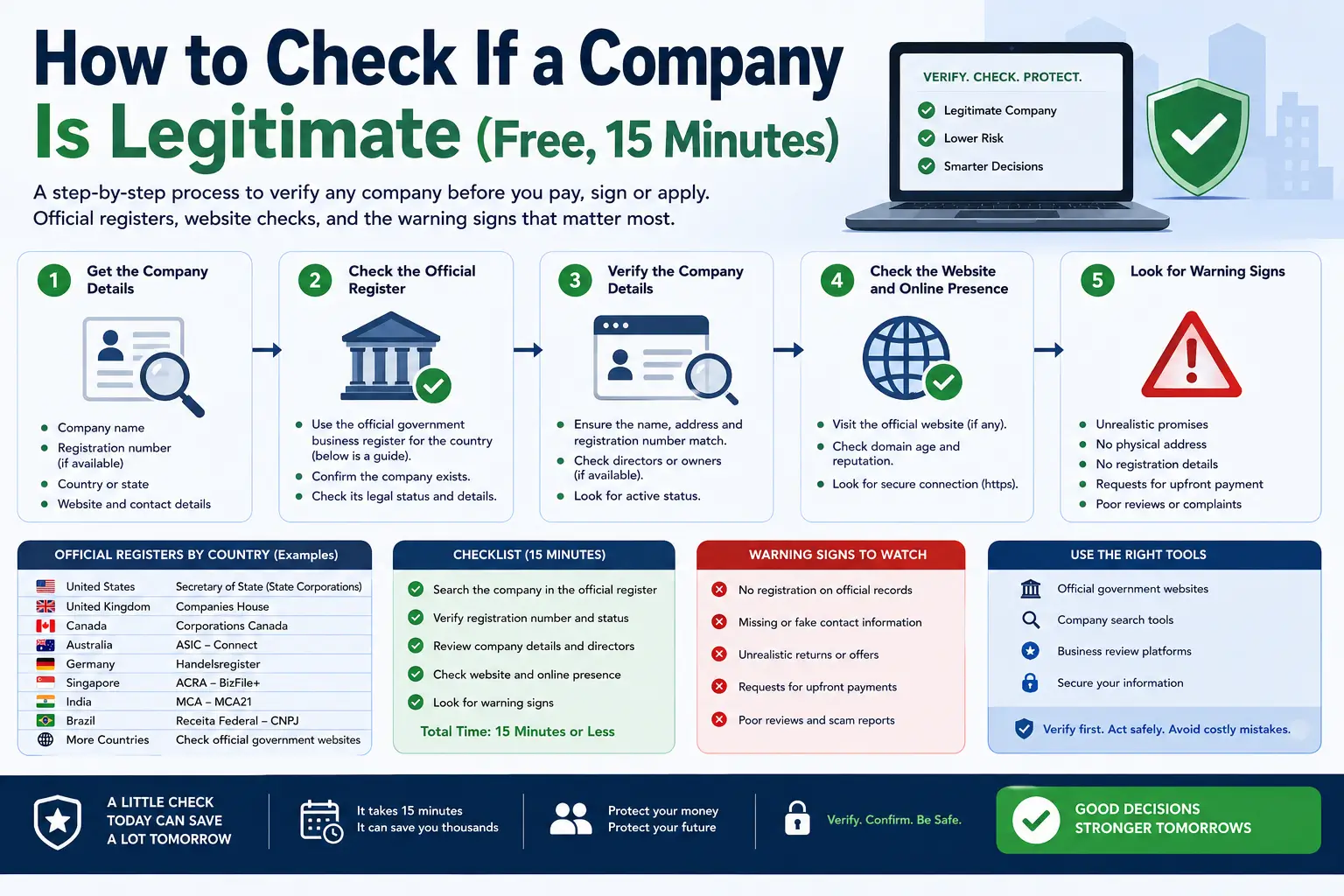
Someone emails you a contract. A supplier asks for a deposit. A recruiter offers a role at a company you have never heard of. A debt collector calls claiming you owe money.
In every one of those situations, the same question comes first, and most people answer it by feel. Is this a real company? You can answer it properly in about fifteen minutes, for free, and you do not need any special access.
SHORT ANSWER
Verify a company in four layers, cheapest and hardest to fake first:
- Official register. Does the legal entity exist and is it active? This is the only step with legal weight.
- Digital footprint. Domain age, website, and whether the email domain matches the company.
- Independent traces. Regulator listings, press, court records, employee profiles.
- Direct contact. Phone the number on the official record, not the one in the email.
A company can pass all four and still be a bad business partner. Verification proves existence, not quality.
1. Why “it has a nice website” proves nothing
A convincing website costs almost nothing now. A domain is a few dollars. A polished template is free. Stock photos of a fake team take ten minutes. AI writes the About page.
So when people say “it looked legitimate”, what they usually mean is “it looked expensive”. Those are different things, and the gap between them is exactly where fraud lives.
Real verification works the other way round. Start with the records that are hard to fake because a government maintains them, and treat everything the company controls as unverified until it lines up.
| Signal | Cost to fake | Evidential value |
|---|---|---|
| Professional website | Almost nothing | Very low |
| Social media presence | Almost nothing | Very low |
| Company email address | Almost nothing | Low |
| Registered company entry | Low, but leaves a trail | Moderate |
| Ten year filing history | Very hard | High |
| Regulator licence | Very hard | High |
| Court and press record | Cannot be faked | High |
Notice that the things people check first sit at the top of that table, and the things that actually prove something sit at the bottom.
2. Layer 1: the official register
Start here every time. Everything else is softer.
- Find the legal entity name: It is often different from the brand name. Look in the website footer, the terms of service, the privacy policy, or the small print on an invoice. You are looking for something like “Acme Digital Ltd, registered in England and Wales, company number 12345678”.
- Search the register for that country: The UK, Switzerland and Singapore are free and need no account. Germany, Hong Kong and Italy are searchable with fees for documents. The United States has no national register, so you need the Secretary of State of the correct state, or SEC EDGAR if the company is listed. Our company registry search guide covers where each one lives.
Check four fields:
- Status. Active is what you want. “Dissolved”, “struck off” or “in liquidation” changes everything.
- Incorporation date. Compare it against what they claim. A company “serving clients since 2009” that incorporated last March needs explaining.
- Registered address. Note it. You will compare it in a moment.
- Officers. Do the names match the people you are dealing with?
A registered address is often a lawyer or a formation agent, not an office. That alone is not suspicious. Thousands of legitimate companies use one. It becomes a question when a company claims a large operation and its only address is a mail forwarding service shared with four hundred other entities.
If the register shows nothing, do not panic yet. Sole traders and partnerships are not required to register in many countries, and the brand name may differ from the legal name. But if a company presents itself as a limited company and you cannot find it, that is now the only thing you need to resolve.
3. Layer 2: the digital footprint
Now check whether the company’s own presence supports the story.
- Domain age: A public WHOIS lookup shows when the domain was registered. A company claiming a decade of trading on a domain created four months ago is a contradiction that needs an answer. Rebrands happen, so ask rather than assume.
- Does the email domain match? A business emailing you from a free webmail account while claiming to be an established firm is a meaningful signal. Not proof, but a signal.
- Does the website match the register? Compare the legal name, the company number and the address on the site against the register. Mismatches are common through carelessness, but they are worth asking about.
- Do the contact details work? Call the phone number. Check the address on a map. An “office” that is a residential flat, an empty lot, or a virtual office when they claim a headquarters is worth knowing before you pay.
- Is the website actually the company’s? Confusion between similar names is a real and boring source of error. “Bolt” is a ride-hailing company, a payments company, and a materials company. If you are checking one, make sure you are on the right one. Our free company URL finder shows alternative candidates for exactly this reason.
4. Layer 3: independent traces
The strongest evidence is the evidence the company cannot control.
- Regulator listings: If they operate in a licensed field- finance, insurance, healthcare, legal, recruitment- they should appear in the regulator’s public register. Check it directly on the regulator’s own site. A licence number on a website means nothing until you have found it in the register.
- Press and news: A genuinely trading company usually leaves some trace: a local paper, an industry publication, a supplier announcement. Total silence for a company claiming significant scale is odd.
- Court records. Many jurisdictions publish judgments and insolvency notices. Free to search, rarely checked.
- Employee profiles: Do people list this employer publicly, with histories that predate the company’s supposed founding in sensible ways? A company claiming two hundred staff with three findable employees does not add up.
- Reviews, read properly: Ignore the star rating. Read the one and two star reviews and look for a pattern, especially in how the company responds. Complaints about a product are normal. Repeated complaints about money not arriving are not.
5. Layer 4: contact them the hard way
This step catches impersonation, which is the category most people miss entirely.
- Call the number from the official record, not the one in the email: Impersonation works by giving you contact details that route back to the impersonator. If someone claims to be from a real company, look that company up independently and use the number you find yourself.
- Ask a question only the real company could answer: Your account number, the specific invoice, the name of the person you dealt with last month.
- Never let urgency skip this: “The offer expires today” and “pay now to secure the shipment” exist to stop you doing exactly this step. Genuine businesses survive a twenty-four hour delay.
6. The warning signs ranked by how much they matter
Not all red flags are equal. These are ordered by how strongly they predict a problem.
Serious. Stop and resolve before proceeding.
- No trace in the register of the country they claim to be incorporated in.
- Register status shows dissolved, struck off, or in liquidation.
- Payment requested to a personal account, in cryptocurrency, or by gift card.
- Bank details that do not match the company name.
- Refusal to provide a company registration number when asked directly.
- Pressure to pay before you have verified anything.
Worth investigating.
- Domain registered very recently against claims of a long history.
- Registered address is a mail forwarding service and they claim a large operation.
- Free webmail address for a supposedly established company.
- No findable employees or press coverage at all.
- A licence number that does not appear in the regulator’s own register.
- Website copy that reads as though it was generated and never edited.
Weak on their own.
- A small or basic website. Plenty of real firms have one.
- Few social media followers. Many B2B companies barely use social media.
- Being a young company. Everyone was once.
- Being registered in a jurisdiction with strong privacy rules. Common and often legitimate.
The pattern matters more than any single item. One weak signal is noise. Three or four together, especially with a serious one, is a decision.
7. Special cases
Debt collectors
If someone contacts you about a debt, check the company in the register and in the relevant regulator’s list of licensed collectors before you discuss anything or pay anything. Never confirm personal details to an inbound caller. Hang up, find the company yourself, and call back on a number you sourced independently. Real collectors expect this.
Recruiters and job offers
Verify the employer in the register, then find the recruiter’s profile independently and check it predates the vacancy. The clearest fraud signal in recruitment is being asked for money at any point: for training, equipment, visa processing or background checks. Legitimate employers do not charge candidates.
Overseas suppliers
Ask for the registration number in the local format and verify it on the local register rather than accepting a scanned certificate, which is trivial to alter. In Hong Kong, records are retrievable through the Companies Registry for a fee. In China, verification is possible through the official enterprise information system, though the interface is Chinese-language. In restricted jurisdictions such as the British Virgin Islands, meaningful searches usually require a registered agent.
For a first order, structure payment so you are not fully exposed, and match the bank account name to the registered company name exactly. Mismatched beneficiary names are one of the most reliable fraud signals in international trade.
Frequently asked questions
How do I check if a company is legitimate for free?
Search the official company registers for the country where it is incorporated. The UK, Switzerland and Singapore are free with no account. Then check the domain age, confirm contact details independently, and look for regulator listings, press coverage and court records. That whole sequence costs nothing.
What is the fastest single check?
The official register. It is the only step with legal weight, and it takes about two minutes when you know which country to search. Everything else is supporting evidence.
Does a company registration number prove a company is trustworthy?
No. It proves a legal entity was registered. Anyone can register a company. The number lets you look up the real record, and the record is what tells you something. Treat the number as a key, not as an endorsement.
How can I tell if a website belongs to the real company?
Compare the legal name, company number and registered address on the site against the register. Check the domain registration date. Be careful with shared names: several unrelated companies trade as Bolt, Mercury and Atlas, so confirm you are looking at the right one before concluding.
What if I already paid a company that turns out to be fake?
Contact your bank or card provider immediately, because some payments can be recalled if you act quickly. Report it to your national fraud reporting body and to the platform where you found them. Keep every message, invoice and payment record. Speed matters far more than completeness at this stage.
Is a company in a low tax jurisdiction automatically suspicious?
No. Many entirely legitimate businesses are incorporated in places like the BVI, Delaware or Singapore for ordinary commercial reasons. What matters is whether you can verify the entity, whether the story is consistent, and whether they answer direct questions. Evasiveness is the signal, not the address.
Start with the company’s real website
Half of verification failures come from checking the wrong company. Our free company URL finder turns company names into official domains, scores each match, and shows the other candidates so you catch the ambiguous ones before they cost you. No sign-up.
Also in this series: company registry search by country and what a company registration number is.