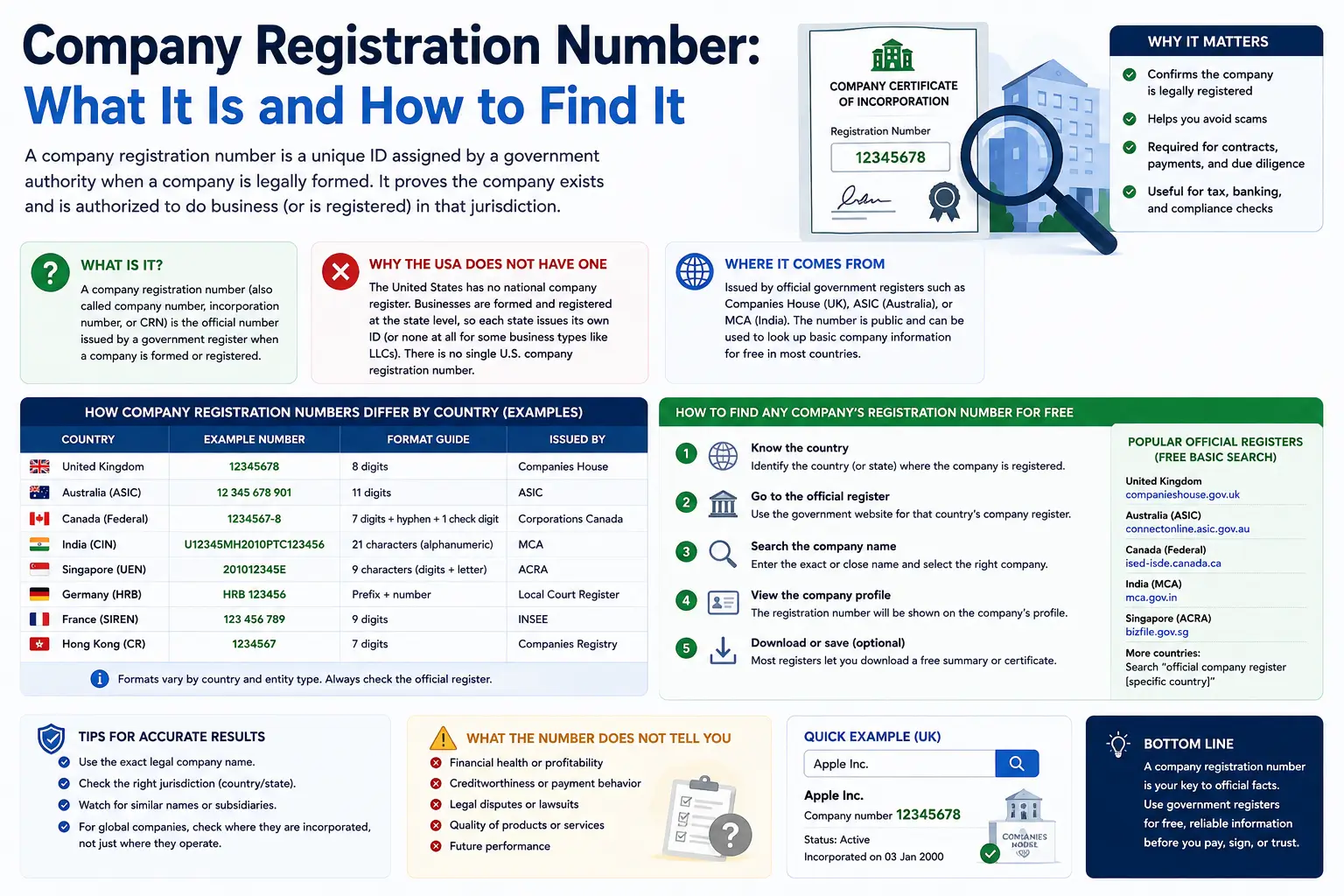
Company names are a terrible way to identify a business. They repeat, they change, they get abbreviated, and three unrelated firms can share one. The registration number does not have any of those problems, which is why every serious piece of company research uses it instead.
If you work with suppliers, customers, or company data, this is the single most useful field you can learn to find.
SHORT ANSWER
A company registration number is the unique identifier a government registrar assigns when a company is legally incorporated. It never changes, even if the company renames or moves.
Formats differ by country: the UK uses 8 characters, Switzerland uses
CHE-XXX.XXX.XXX, Singapore uses a UEN. The United States does not issue a national company number at all, because companies register at state level. A US EIN is a tax number, not a registration number, and the two are frequently confused.You can usually find it for free in the website footer, on an invoice, or by searching the official register.
1. What the number actually is
When a registrar incorporates a company, it assigns an identifier. That identifier is permanent. The company can rebrand, relocate, change directors and change owners, and the number stays the same.
That permanence is the whole point. It gives you a stable key for a thing that otherwise keeps moving.
Consider what happens without it. Your CRM has “Acme Ltd“, “Acme Limited”, “ACME LTD.” and “Acme Group” as four separate accounts. Are they one company or four? The name cannot tell you. The registration number can, instantly.
Different countries call it different things, and they all mean roughly the same thing:
| Term | Where |
|---|---|
| Company number, CRN | United Kingdom |
| UID | Switzerland |
| UEN, Unique Entity Number | Singapore |
| Handelsregisternummer | Germany |
| Entity number, file number, charter number | United States, varies by state |
| CIN, Corporate Identity Number | India |
| ABN, ACN | Australia |
This is the field to store in your database. If you are building any kind of company dataset, capture the registration number and the jurisdiction together. A number without a country is ambiguous, because numbering starts from scratch in every jurisdiction.
2. Why the USA is the confusing one
This causes more confusion than everything else on this page combined, so it gets its own section.
The United States does not have a national company register, and therefore has no national company registration number.
Companies incorporate at the state level. A company formed in Delaware exists in Delaware’s records. One formed in Utah exists in Utah’s records. There is no federal registry stitching them together and no federal identifier equivalent to a UK company number.
What this means in practice:
- A US company has a state-issued entity number, sometimes called a file number or charter number, valid only within that state’s system.
- Formats vary from state to state. There is no common pattern.
- To look one up, you need to know which state, then use that state’s Secretary of State search.
- If the company is publicly listed, it will also have a CIK number in the SEC’s EDGAR system, which is a federal identifier but only exists for filers.
So if someone asks you for “the US company registration number”, the honest answer is a question: which state, and do you want the state entity number or the EIN? They are not the same thing, which brings us to the next section.
3. Registration number versus tax number
These get mixed up constantly, including by people who should know better. They are different identifiers, issued by different bodies, for different purposes.
| Registration number | Tax number | |
|---|---|---|
| Issued by | The company registrar | The tax authority |
| Purpose | Proves the entity legally exists | Identifies it for tax |
| Public? | Yes, that is the point | Usually no |
| UK example | Company number | VAT number, UTR |
| US example | State entity number | EIN |
| Switzerland | UID (also used for VAT) | UID |
Two practical rules:
- Do not ask for a tax number when you want a registration number: In most countries, a tax number is not public, and asking for it looks either careless or suspicious. The registration number is public by design.
- A US EIN is not a registration number: It is a federal tax identifier; it is not publicly searchable, and having one does not prove a company is properly registered in any state. If someone offers an EIN as proof of legitimacy, they have answered a different question than the one you asked.
Switzerland is a useful exception worth knowing: the UID is a genuinely universal identifier used across the commercial register, VAT, social insurance, customs and statistics. That makes it the single join key for Swiss company data.
4. Formats by country
Knowing the shape of a number lets you spot a wrong or invented one immediately.
United Kingdom
Eight characters. Plain numeric for companies registered in England and Wales, with a two-letter prefix for other parts of the UK: SC for Scotland, NI for Northern Ireland. So 12345678, SC123456 and NI123456 are all valid shapes.
Companies House records go back to 1844 for some entity types, making it one of the historically deepest registers in the world.
Switzerland
CHE-XXX.XXX.XXX. The CHE stands for Confoederatio Helvetica. Issued by the Federal Statistical Office since 2011 and used across the commercial register, VAT, social insurance, customs and statistics.
Singapore
A UEN, the Unique Entity Number, searchable free on ACRA’s Bizfile portal alongside the company name.
Germany
A Handelsregisternummer, tied to the local Amtsgericht where the company registered. Because the court is part of the identity, a German number is not fully meaningful without knowing which court issued it.
United States
No national format. Each state issues its own entity or file number with its own pattern. Listed companies additionally have a CIK in SEC EDGAR.
A quick sanity check. If someone gives you a “UK company number” with ten digits, or a “Swiss UID” without the
CHEprefix, something is wrong. It may be a typo, a different identifier, or invented. Either way, verify it on the register before you use it.
5. Four ways to find any company’s number
In order of speed.
1. The website footer
The fastest and most overlooked. Many jurisdictions legally require companies to display their registration number on their website and correspondence. Scroll to the bottom of the homepage and look for a line like “Registered in England and Wales, company number 12345678”.
2. Terms, privacy policy or invoices
If the footer has nothing, check the terms of service, the privacy policy, or the small print at the bottom of any invoice or quote. Legal pages almost always name the legal entity, and the legal entity name is frequently different from the brand you know.
3. Search the official register
Search by company name on the register for that country. The UK, Switzerland and Singapore are free with no account needed. Germany, Hong Kong and Italy let you search with fees for documents. Our company registry search guide covers where each one lives and what each costs.
This is also the step that catches the common failure: searching the wrong country. Where a company operates and where it is incorporated are often different.
4. Just ask
Legitimate companies give it out without hesitation. It is public information. If a company will not tell you its registration number when you ask directly, you have learned something more useful than the number itself.
6. How to use it once you have it
Deduplicate your data with it. Matching company records on name is unreliable. Names have variants, abbreviations and typos, and different companies share them. Matching on registration number plus jurisdiction is close to exact. If you are cleaning a company list, the number is what you want to resolve to.
Verify claims against it. Pull the register entry and compare incorporation date, status, address and officers against what the company has told you.
Monitor status changes. Many registers publish changes. A supplier moving from “active” to “in liquidation” is something you want to learn from the register, not from an unanswered invoice.
Store the jurisdiction with it. Always. 12345678 on its own is meaningless. GB 12345678 is a fact.
The number is a key, not a verdict. Anyone can register a company. Having a valid registration number proves an entity exists and gives you a reliable way to look it up. What you find when you look it up is the actual answer. That process is covered in how to check if a company is legitimate.
Frequently asked questions
What is a company registration number?
The unique identifier a government registrar assigns when a company is legally incorporated. It is permanent, it is public, and it identifies the company far more reliably than its name, which can change or be shared with other businesses.
Does the USA have a company registration number?
Not nationally. The United States has no federal company register, so there is no national company number. Companies receive a state-issued entity or file number from the state where they incorporated, and formats differ from state to state. Publicly listed companies also have a CIK number in SEC EDGAR.
Is an EIN the same as a company registration number?
No. An EIN is a federal tax identifier issued by the IRS. A registration number is issued by a state registrar and proves the entity legally exists. An EIN is not publicly searchable and does not confirm that a company is properly registered anywhere.
Where do I find a company’s registration number for free?
Check the website footer first, then the terms of service or privacy policy, then an invoice. If none of those show it, search the official register for the country of incorporation. The UK, Switzerland and Singapore are free.
Can a company registration number change?
Normally no. It stays the same through rebrands, address changes and ownership changes, which is exactly why it is more useful than the name. It can change in genuine structural events such as a re-incorporation in a different jurisdiction, but that creates a new entity rather than renumbering the old one.
Why do two companies have the same registration number?
Almost always because they are in different countries. Numbering restarts in every jurisdiction, so a UK number and a Singapore number can collide by coincidence. This is why you must always store the jurisdiction alongside the number.
How do I check whether a registration number is real?
Search it on the official register for that country. If the number returns no entity, or returns a company with a different name than the one you were given, treat that as a serious problem and resolve it before proceeding.
From a name to a number to a website
Company research usually runs in that order: you start with a name, you find the legal entity and its number, and you need the actual website to do anything useful. Our free company URL finder handles the last step in bulk, turning a list of company names into official domains with a match score and CSV export. No sign-up.