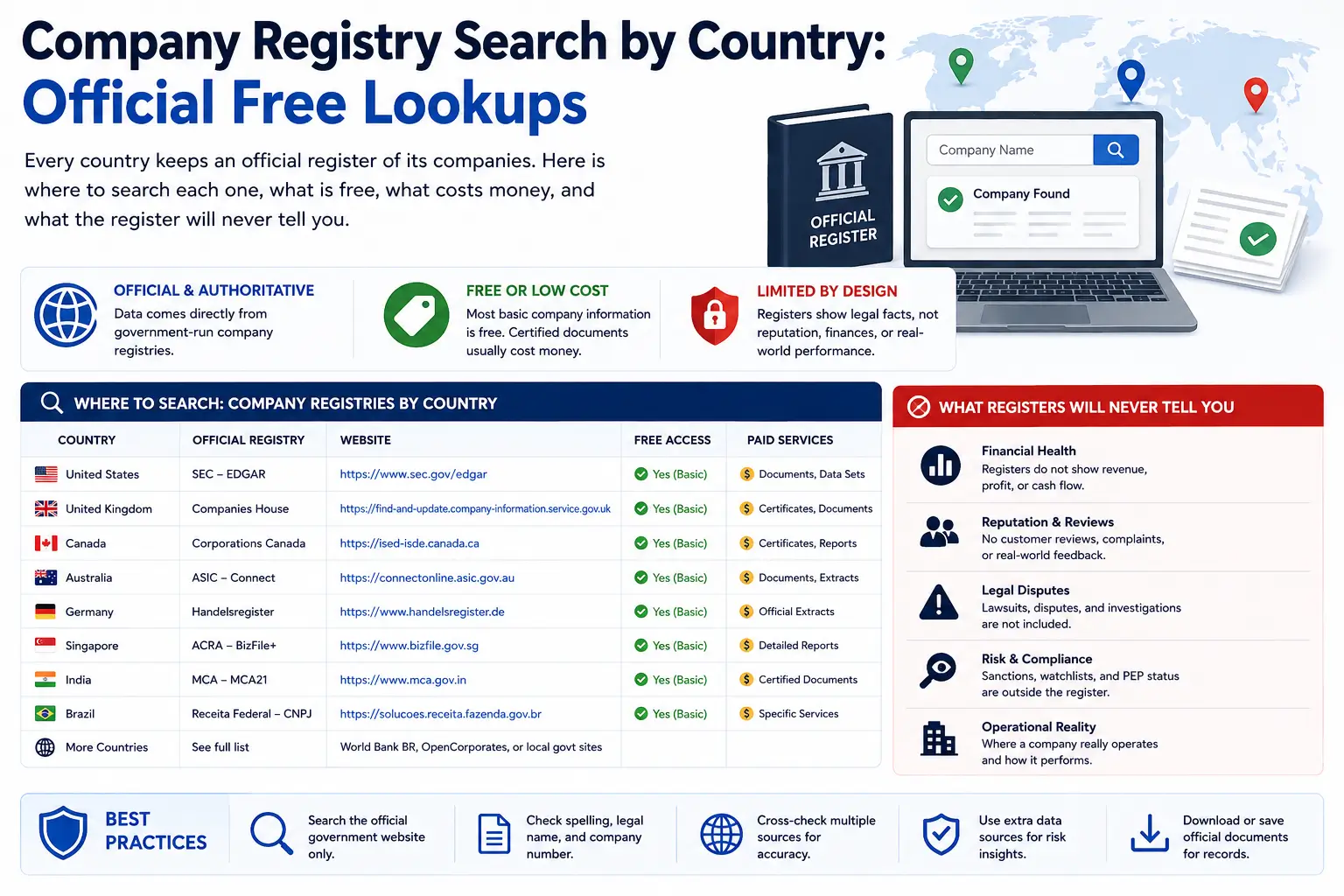
Before you sign a contract, wire a deposit, or add an account to your pipeline, there is one check worth doing that almost nobody does: look the company up in the official register of the country where it was incorporated.
It takes two minutes, it is free in most countries, and it answers the only question that really matters first. Does this company legally exist, and is it in good standing right now?
SHORT ANSWER
Every country keeps an official register of the companies incorporated there, and most let you search it for free. The United Kingdom (Companies House), Switzerland (Zefix) and Singapore (Bizfile) are free with no account. Germany, Hong Kong and Italy are searchable but charge for documents. The United States has no national register at all, only fifty state registers plus SEC EDGAR for listed companies. Offshore jurisdictions such as the British Virgin Islands are deliberately restricted.
A register tells you a company exists and its current status. It will not tell you whether the company is any good to deal with.
1. What a company register actually is
A company register is a government record of every company legally incorporated in that country. Registration is what brings a company into existence. In most jurisdictions, a limited company does not exist until the registrar enters it.
That makes the register the primary source. Not a directory, not a data vendor, not LinkedIn. When those disagree with the register, the register wins.
Three things it reliably answers:
- Does this legal entity exist?
- What is its current status? Active, dissolved, struck off, in liquidation.
- What is its official identifier? The registration number you should be using instead of the name.
Two things people wrongly expect it to answer:
- Whether the company pays its bills. It has no idea.
- Who really owns it. Sometimes yes, often no. See section 3.
The single most useful output is not the name, it is the number. Company names change, get copied and get abbreviated. The registration number does not. Once you have it, every later check gets easier and more accurate.
2. Country by country: where to search
Below are the registers we checked directly while writing this. It is not every country in the world. It is the ones we could verify, which is a more useful list than a longer one we could not.
United Kingdom
- Register: Companies House
- Search: find-and-update.company-information.service.gov.uk
- Cost: Free
The most open major register in the world. Company name, number, registered office, incorporation date, SIC code, status, current and former officers, the full filing history with downloadable documents, and the People with Significant Control register are all free. There is a free REST API, and the data is published under the Open Government Licence, so commercial reuse is permitted with attribution.
Company numbers are eight characters. A SC prefix means Scotland, NI means Northern Ireland. Note that sole traders and general partnerships are not required to register, so absence from Companies House does not by itself mean a business is fake.
United States
- Register: There isn’t one nationally
- Search: The Secretary of State of the relevant state, plus sec.gov for listed companies
- Cost: Mostly free
This trips people up constantly. The United States has no federal company register. Companies incorporate at the state level, so a US company exists in Delaware’s records, or California’s, or Utah’s, and nowhere central.
If you do not know the state, you may have to check several. Most Secretary of State search tools are free for basic registration data. For publicly listed companies, SEC EDGAR at sec.gov is free and holds the full filing archive.
Switzerland
- Register: Zefix, the Central Business Name Index
- Search: zefix.ch
- Cost: Free
Switzerland has 26 cantonal registers and no single national one, so the federal government runs Zefix as the central index across all of them. It has been free since 2021, needs no account, has no search limit, and works in English, German, French and Italian. It holds over 800,000 entries, including dissolved companies.
You can download an uncertified register extract as a PDF at no cost. Certified extracts cost CHF 50 from the cantonal office. There is also a free REST API.
One quirk worth knowing: for a GmbH the quota holders are public, but for an AG the shareholders are not.
Singapore
- Register: ACRA, via the Bizfile portal
- Cost: Free basic search, paid profile
Bizfile replaced the older BizFile+ system in December 2024. The free entity search by company name or UEN returns the name, status, registered address and entity type, which is enough to confirm legal existence. The fuller Business Profile with paid-up capital, shareholders and charges costs S$5.50 per company.
Germany
- Register: Handelsregister
- Cost: Searchable, small fee for extracts
German companies register with the commercial register at the local Amtsgericht, which is why the registration number is tied to a specific court. A simple extract typically costs around ten euros.
Hong Kong
- Register: Companies Registry, via ICRIS
- Search: icris.cr.gov.hk
- Cost: Paid, account required
Hong Kong is searchable but not free. Document fees generally run from HKD 22 to HKD 340 depending on what you pull, and you need an account before you can retrieve records.
Italy
- Register: Registro delle Imprese
- Cost: Searchable, paid documents
Run by the Chambers of Commerce and coordinated nationally by InfoCamere. It is one of the more comprehensive registers in Europe, covering companies, partnerships, cooperatives and branches of foreign entities, with legal and financial disclosures.
British Virgin Islands
- Register: Registry of Corporate Affairs, under the Financial Services Commission, using the VIRRGIN system
- Cost: Restricted
The BVI is deliberately different, and sources currently disagree about how open it is. Historically, meaningful searches had to go through a BVI-licensed registered agent or legal practitioner with VIRRGIN access, and several guides still describe it that way. At least one 2026 guide reports that a basic public search covering company names, numbers and previous names went live in December 2025.
What is consistent across every source: beneficial ownership is not publicly searchable. Director names became accessible in 2023, and from April 2026 applicants who can demonstrate a legitimate interest may request ownership data, with the beneficial owner notified and able to object.
If you need certainty on a BVI entity, budget for a registered agent search rather than assuming you can do it yourself in five minutes.
We stopped the list here on purpose. Mexico, France, Hungary, India and China all have official registers, and we did not verify their current access rules closely enough to write them down with confidence. Publishing a URL we have not checked would make this page look more useful and be less useful. If you need one of those, tell us and we will verify it and add it.
3. What every register shows, and what none of them show
Registers vary a lot in what they publish, but the pattern is consistent.
| Data point | Usually public | Notes |
|---|---|---|
| Legal name | Yes | Often includes former names |
| Registration number | Yes | The identifier you actually want |
| Status | Yes | Active, dissolved, struck off, in liquidation |
| Registered address | Yes | Often a registered agent, not a real office |
| Incorporation date | Yes | Useful sanity check against “founded in” claims |
| Directors and officers | Often | UK yes, BVI since 2023, Switzerland yes |
| Shareholders | Sometimes | Swiss GmbH yes, Swiss AG no, Singapore paid |
| Beneficial owners | Rarely | Switzerland’s new register is non-public, BVI restricted, Hungary non-public |
| Accounts and financials | Varies | UK yes, many registers no |
What no register will tell you
- Whether they pay on time. That is a credit reference agency’s job, not a registrar’s.
- Whether they are any good. Registration is a filing, not an endorsement.
- Whether the address is real. Registered offices are frequently a law firm or formation agent.
- Who is really behind it. In many jurisdictions, ownership is filed but not public.
4. Free versus paid, and the sites that pretend to be official
There is a whole industry of sites that copy the look of official registers and charge for information that is free at the source. Switzerland’s situation is a good example: several commercial sites mimic Zefix and sell documents that Zefix gives away.
How to tell you are on the real one:
- Check the domain. Official registers sit on government domains:
.gov.uk,.gov.sg,.gov.hk,zefix.chunder the Federal Office of Justice. - Be suspicious of any site charging for a basic name search in a country where basic search is free.
- If a site asks for a card before showing you anything at all, it is almost certainly a reseller.
Paid intermediaries are not automatically bad. For BVI and other restricted registers, they are the only route. Just know when you are paying for access you could have had for nothing.
5. How to use this in a real check
A workable order of operations, cheapest and fastest first.
- Get the country right. Where is the company incorporated, not where does it have an office? A UK-facing website may belong to a Delaware entity.
- Search the register for that country. Confirm the entity exists and is active.
- Copy the registration number. Use it in every later step instead of the name.
- Check the incorporation date against whatever the company claims about its history.
- Check the status carefully. Struck off and in liquidation are not “active with a small issue”. They change whether you should proceed at all.
- Match the registered address against the address on their invoices and website. A mismatch is not automatically bad, but it is a question worth asking.
- Only then move on to the softer signals: website, reviews, hiring activity, press.
Step seven is where most people start. Doing it first is how you end up impressed by a company that legally dissolved eighteen months ago.
Frequently asked questions
Is there a global company register?
No. There is no single worldwide register and no organisation that maintains one. Every country runs its own, with its own rules, fees and access levels. Aggregator services stitch several together, but the authoritative record always sits with the national registrar.
Is a company registry search free?
It depends on the country. The UK, Switzerland and Singapore offer free basic searches with no account. Germany, Hong Kong and Italy let you search but charge for documents. Restricted jurisdictions such as the BVI generally require a registered agent. Nowhere charges more for the truth than for the copy, so always start at the official source.
Which country’s register should I search?
The one where the company is incorporated, which is not always where it operates or where its website is aimed. Look for a registration number, a registered office or a legal entity name in the website footer, terms of service, or privacy policy. That usually tells you the jurisdiction.
Why can I not find a US company in a national register?
Because there is no national register. US companies incorporate at the state level, so you need the Secretary of State of the correct state. If the company is publicly listed, SEC EDGAR at sec.gov is the fastest route and is free.
Does being in the register mean a company is trustworthy?
No, and this is the most common mistake. Registration confirms that a legal entity exists and what its current status is. Anyone can register a company. The register is a starting point for due diligence, never the conclusion.
What if the company is not in any register?
It may be a sole trader or a partnership, which many countries do not require to register. It may be trading under a brand name that differs from its legal name. Or it may not exist. Check the brand name against the legal name in the website footer before concluding anything.
Once you have the company, get its website
Official registers give you legal entities. They rarely give you a usable website. Our free company URL finder turns a list of company names into official domains with a match score, so you can pair the legal record with the actual online presence. No sign-up.
Next in this series: how to check whether a company is legitimate, which puts the register check into a full verification process.