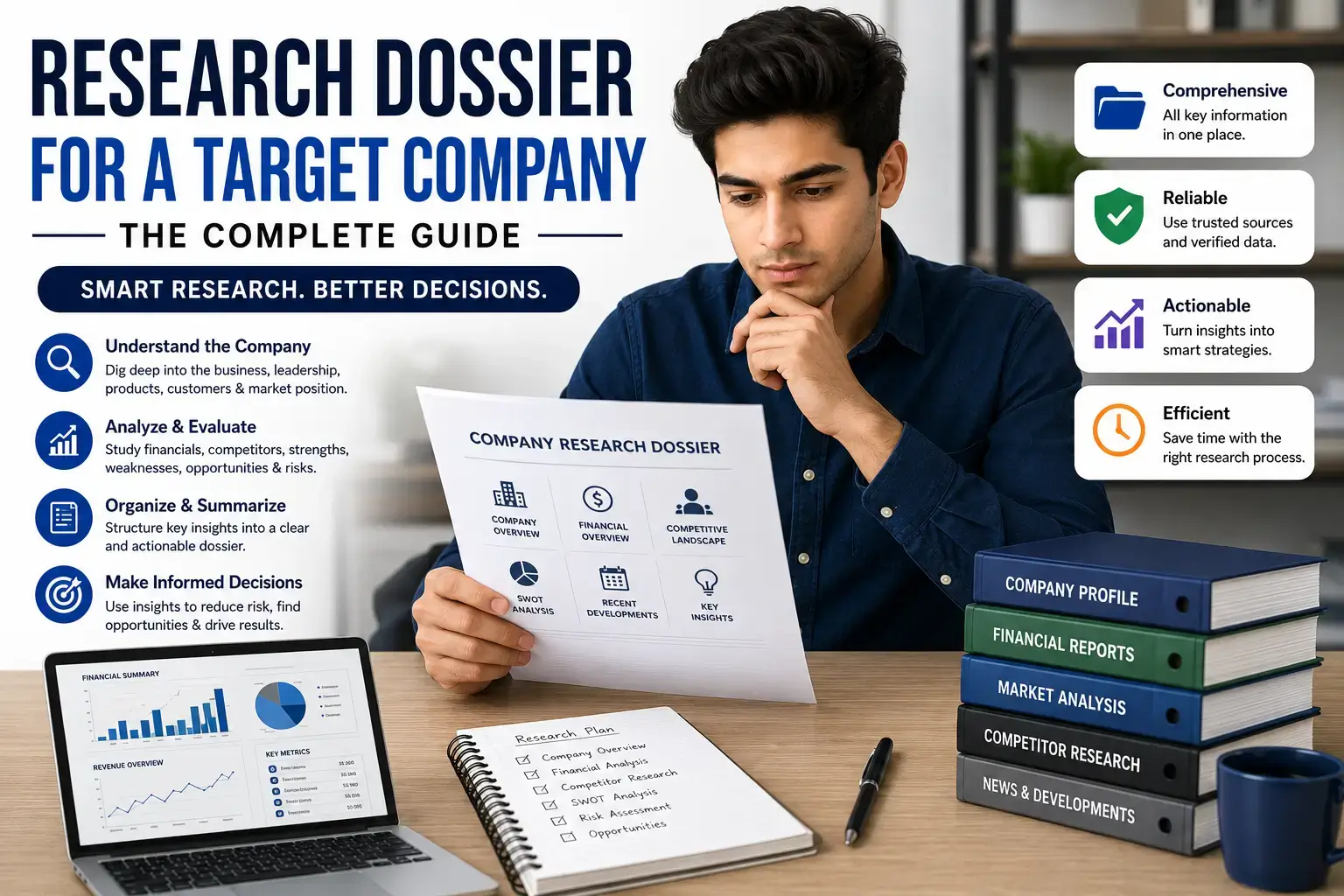
A research dossier for target company is a structured document that gathers verified information about a business before making an important decision. Sales teams use it before client meetings, investors rely on it for due diligence, recruiters prepare with it before interviews, and consultants build it before recommending strategies. Instead of collecting random facts, a good dossier transforms company information into actionable business intelligence.
This guide explains what a company research dossier is, why it matters, what to include, where to find reliable data, and how AI can speed up the research process without compromising accuracy.
What Is a Research Dossier for Target Company?
A research dossier is a comprehensive report that summarizes all the important information about a company in a single, organized document.
Unlike a basic company profile, a dossier goes deeper by combining publicly available information, financial data, competitive insights, leadership details, customer analysis, and market positioning into a format that supports better business decisions.
A well-prepared dossier answers questions such as:
- What does the company actually do?
- How does it generate revenue?
- Who are its competitors?
- What products or services drive growth?
- What risks or opportunities exist?
- What recent developments could affect future performance?
The objective is not to collect the most information—it is to collect the most useful information.
Why Businesses Create Research Dossiers
Organizations invest time in company research because informed decisions reduce risk.
For example, a sales representative preparing for a meeting with a manufacturing company can identify recent product launches, expansion plans, and executive priorities before proposing. This creates conversations that feel personalized rather than generic.
Similarly, investors evaluate financial health, competitive position, leadership quality, and market opportunities before committing capital.
Consultants use research dossiers to understand clients before recommending strategic improvements.
Recruiters review company culture, growth history, and executive leadership before interviews.
Although their objectives differ, they all depend on the same principle:
Better information leads to better decisions.
When Should You Create a Company Research Dossier?
A research dossier becomes valuable whenever an important business decision depends on understanding another company.
Common situations include:
- Enterprise sales meetings
- Partnership negotiations
- Vendor evaluations
- Competitive analysis
- Market research
- Investment due diligence
- Acquisition planning
- Interview preparation
- Business consulting
- Procurement reviews
If significant time, money, or reputation is involved, creating a structured research dossier is usually worthwhile.
Essential Sections Every Research Dossier Should Include
A professional research dossier should organize information into clearly defined sections.
| Section | Purpose |
|---|---|
| Executive Summary | High-level overview |
| Company Overview | Business model, history, headquarters |
| Leadership Team | CEO, founders, executives |
| Products & Services | Main offerings |
| Customers | Target industries and audience |
| Revenue Model | How the business earns money |
| Financial Overview | Revenue, funding, profitability (when available) |
| Competitors | Primary market competitors |
| SWOT Analysis | Strengths, weaknesses, opportunities, threats |
| Technology Stack | Software and digital infrastructure |
| Recent News | Press releases, acquisitions, launches |
| Risk Assessment | Legal, financial, operational risks |
| Strategic Opportunities | Potential business opportunities |
This structure keeps information easy to review and update over time.
Where to Find Reliable Company Information
Not all online sources provide the same level of credibility. A trustworthy dossier should prioritize primary sources whenever possible.
The most reliable places to begin include:
- Official company website
- Investor Relations pages
- Annual reports
- SEC filings (for U.S. public companies)
- Government business registries
- Official press releases
- Product documentation
- Executive interviews
- Earnings call transcripts
Secondary sources can add valuable context but should always be verified.
Examples include:
- Crunchbase
- PitchBook
- CB Insights
- Gartner
- Statista
- Bloomberg
- Reuters
Avoid relying solely on blogs, forums, or AI-generated summaries without verification.
How to Research a Target Company Step by Step
An efficient workflow improves both speed and accuracy.
Step 1: Understand the Business
Identify:
- Industry
- Products
- Services
- Customers
- Geographic markets
This creates the foundation for all later research.
Step 2: Analyze Leadership
Review executive biographies.
Leadership experience often reveals future strategic direction.
Step 3: Review Financial Information
Public companies disclose significant financial data.
Private companies may require estimates from reputable databases.
Step 4: Study Competitors
Compare:
- Pricing
- Market share
- Product positioning
- Customer reviews
- Differentiators
Competitive context makes individual company data more meaningful.
Step 5: Monitor Recent Developments
Focus on:
- Acquisitions
- Funding rounds
- Product launches
- Leadership changes
- Partnerships
- Legal actions
Recent events frequently influence business strategy.
Step 6: Identify Opportunities and Risks
The final step transforms raw information into practical recommendations.
Ask:
- What advantages does this company possess?
- Where are the weaknesses?
- What trends create opportunities?
- Which risks deserve attention?
How AI Can Improve Company Research
Artificial intelligence dramatically reduces research time but should not replace verification.
AI performs best when used to:
- Summarize lengthy reports
- Extract key insights
- Organize research
- Compare competitors
- Generate executive summaries
- Identify missing information
- Draft SWOT analyses
Human researchers should still verify financial figures, legal information, and strategic conclusions using official sources.
The best workflow combines AI efficiency with human judgment.
Common Mistakes to Avoid
Many research dossiers become less useful because they prioritize quantity over quality.
Avoid these common errors:
- Copying marketing language from company websites.
- Using outdated financial information.
- Ignoring competitor analysis.
- Depending entirely on AI-generated content.
- Failing to verify news with trusted sources.
- Collecting information without explaining its business relevance.
A concise, accurate dossier is usually more valuable than a lengthy document filled with unnecessary details.
Best AI and Research Tools
Several tools can improve research efficiency.
| Tool | Best For |
|---|---|
| ChatGPT | Research summaries and drafting |
| Claude | Long-document analysis |
| Perplexity | Source-backed web research |
| Crunchbase | Startup and funding data |
| PitchBook | Private company intelligence |
| Leadership and hiring trends | |
| Google News | Recent developments |
| Reuters | Verified business news |
| SEC EDGAR | Public company filings |
Using multiple sources produces a more balanced and reliable report.
Sample Research Dossier Framework
A practical company dossier can follow this structure:
- Executive Summary
- Company Overview
- Business Model
- Leadership Team
- Products & Services
- Target Customers
- Revenue Sources
- Financial Performance
- Competitor Landscape
- SWOT Analysis
- Recent News
- Technology Stack
- Risks
- Growth Opportunities
- Final Assessment
This framework works well for sales teams, investors, consultants, and procurement professionals.
Original Insight: Why Most Research Dossiers Fail
Most company research reports fail because they answer “What happened?” instead of “Why does it matter?”
A list of facts rarely improves decision-making on its own. The value comes from connecting those facts to business outcomes. For example, knowing a company launched a new product is useful—but explaining how that launch could shift competitive positioning, attract new customer segments, or increase operational complexity is what turns information into insight.
A strong dossier should therefore include analysis alongside evidence, helping readers understand not just the data, but its likely implications.
Best Practices for an Effective Research Dossier
Follow these principles to create a report that remains useful over time:
- Verify every critical claim using authoritative sources.
- Clearly distinguish facts from assumptions.
- Include publication dates for time-sensitive information.
- Update the dossier regularly.
- Keep the structure consistent across companies.
- Use concise summaries before detailed analysis.
- Focus on decision-making rather than information overload.
Conclusion
A research dossier for target company is more than a collection of facts—it is a decision-support tool. Whether you are preparing for a sales meeting, evaluating an investment, conducting due diligence, or researching competitors, a structured dossier helps you understand a company with greater clarity and confidence.
The strongest dossiers combine verified information, thoughtful analysis, and a repeatable research methodology. By using reliable sources, organizing findings logically, and leveraging AI responsibly, you can create reports that save time, reduce risk, and support smarter business decisions.
Frequently Asked Questions
What is a research dossier for target company?
A research dossier is a structured report containing verified information about a company, including its business model, leadership, financial position, competitors, risks, and opportunities.
How is a research dossier different from a company profile?
A company profile provides basic background information, while a research dossier includes analysis, competitive insights, financial data, and strategic observations for decision-making.
Can AI create a complete company research dossier?
AI can accelerate research by summarizing information and identifying patterns, but critical facts should always be verified using official and reputable sources.
What is the ideal length of a company research dossier?
There is no fixed length. Most practical dossiers range from 5 to 20 pages, depending on the depth of analysis and the purpose of the research.
Who benefits most from company research dossiers?
Sales professionals, consultants, investors, procurement teams, recruiters, market researchers, and business development specialists all use research dossiers to make better-informed decisions.